Friday, Dec 5, 2025 |
My interest in research on childcare during WWII grew because I owned and operated a licensed childcare center for 44 children, ranging from 0 (yes, 0 was the number on the license!) to 5 years old, from 1991 to 2007. I hired six staff members and had three separate rooms: Infant, Toddler, and Preschool.
I expected to read that childcare at that time used corporal punishment to make children behave, but I learned something quite different.
****
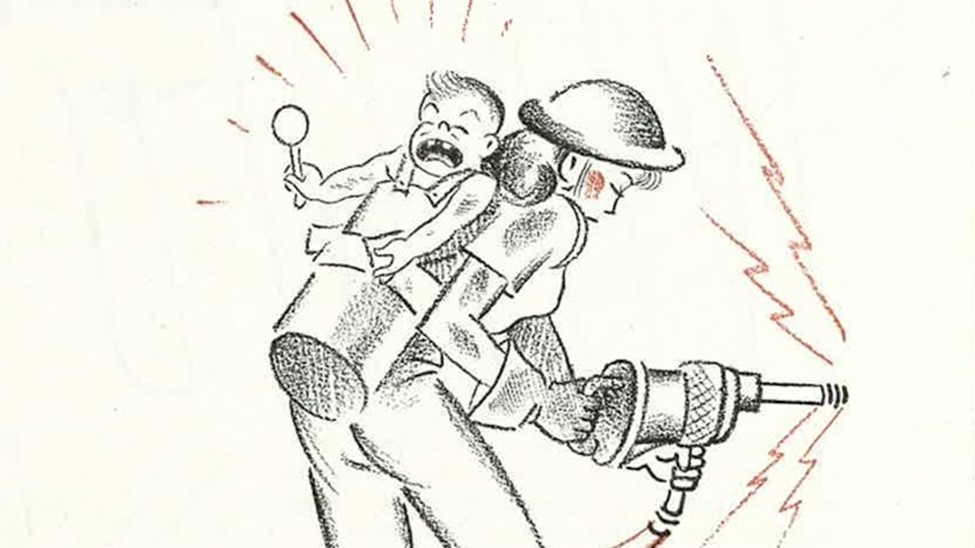
Passage from She Built Ships During WW II
“Good afternoon, I’m Mrs. Stephens, a Victory Visitor.”
“I read about Victory Visitors in the magazine, Ladies’ Home Companion. I’d like to help with the war effort, but I have two young children, and my husband is in the Navy. Besides, my mother used to tell me that the first duty of a mother is to stay with her children,” Lolly exclaimed.
“With most of our men away, our country is facing many difficulties trying to produce all that is needed to win this war,” Mrs. Stephens persisted. “There are evening welding classes at the local high school. You can practice, get a certificate, and a job at the shipyards.”
“At night?” A worry line creased between Lolly’s eyebrows.
“I know a retired teacher who lives down the street and watches children. Just think, you can make $1.20 an hour when you pass!” Mrs. Stephens raised her voice an octave higher.
“That much? I’m barely scraping by with the pittance Joe sent me since I never know when it will arrive.”
****
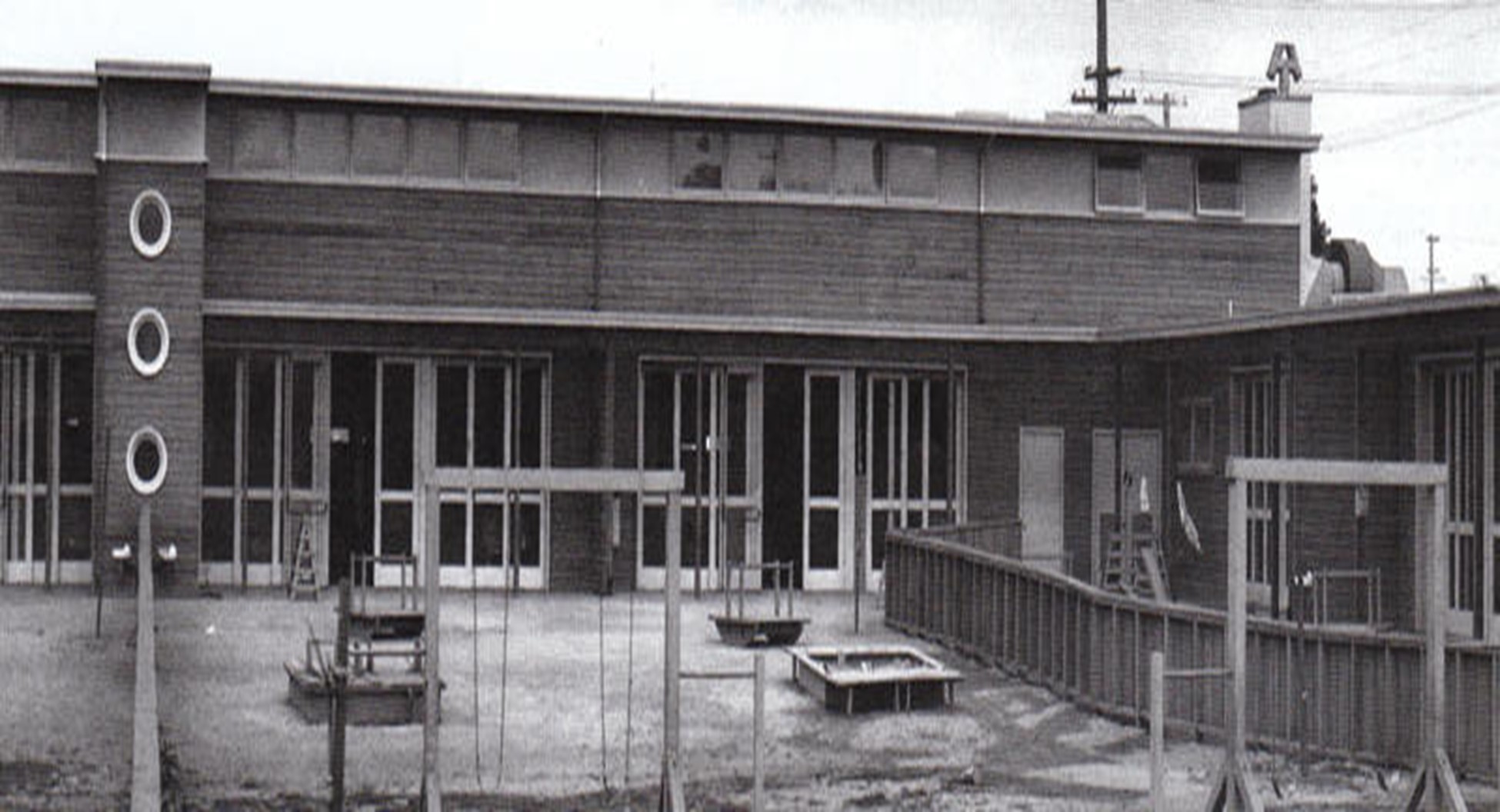
The 1943 Maritime Child Development Center, Richmond, CA
In June 1943, the U.S. Senate passed a bill and $20,000.000 was funded for the first and only universal childcare program to date!
****
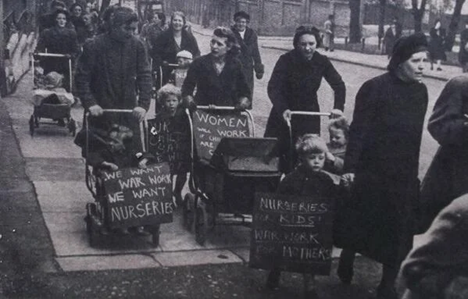
Mothers in Hampstead, England, marching for the opening of more Day Nurseries, 1943
****
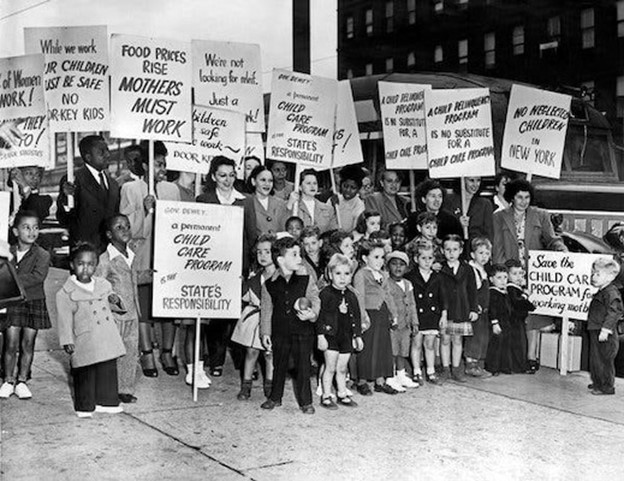
New York mothers protesting for more childcare during World War II
****
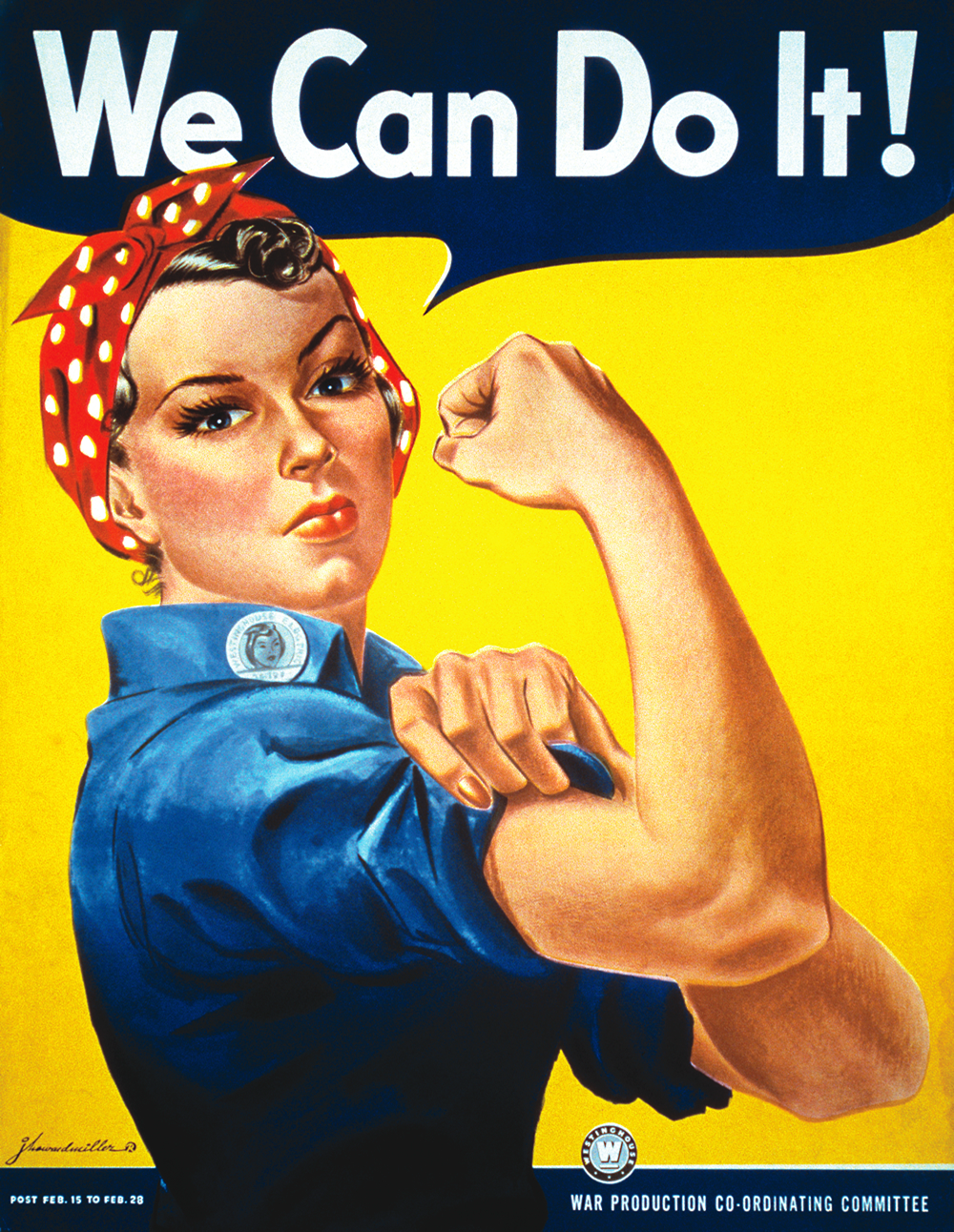
In January 1946, servicemen returned home and took over jobs from women, ending universal childcare.
Wednesday, Nov 12, 2025 |
These incredible volunteer women have been overlooked and forgotten.
Have you ever heard of them?
They went door-to-door in Richmond, CA, and other states and neighborhoods, and played a crucial role in recruiting “ordinary” housewives to help win the war effort during World War II.
Women were needed to support the massive shipbuilding effort at the California Kaiser Richmond Shipyards.
Victory Visitors single-handedly explained to housewives the urgent need for workers in the shipyards, factories, and offices.
Most of the housewives had husbands who were already serving in the military. This personal contact approach was powerful because it made women feel directly needed and part of the national effort.
The Victory Visitors framed employment as a patriotic duty rather than just a job.
They would say, “Your hands can help build the ships that will bring our boys home; you are needed to do your part to help win this war.” This personal contact approach was powerful because it made women feel directly needed and part of the national effort.
The Victory Visitors offered information about bus routes, carpools, and training programs at vocational schools. They explained the many federally funded childcare facilities where children would be safe and well cared for while their mothers worked.
The personal approach of the Victory Visitors shared the stories of housewives who became welders, riveters, and shipfitters, helping break down fear or hesitation about doing factory work.
The Victory Visitors made women feel confident, valuable, and involved.
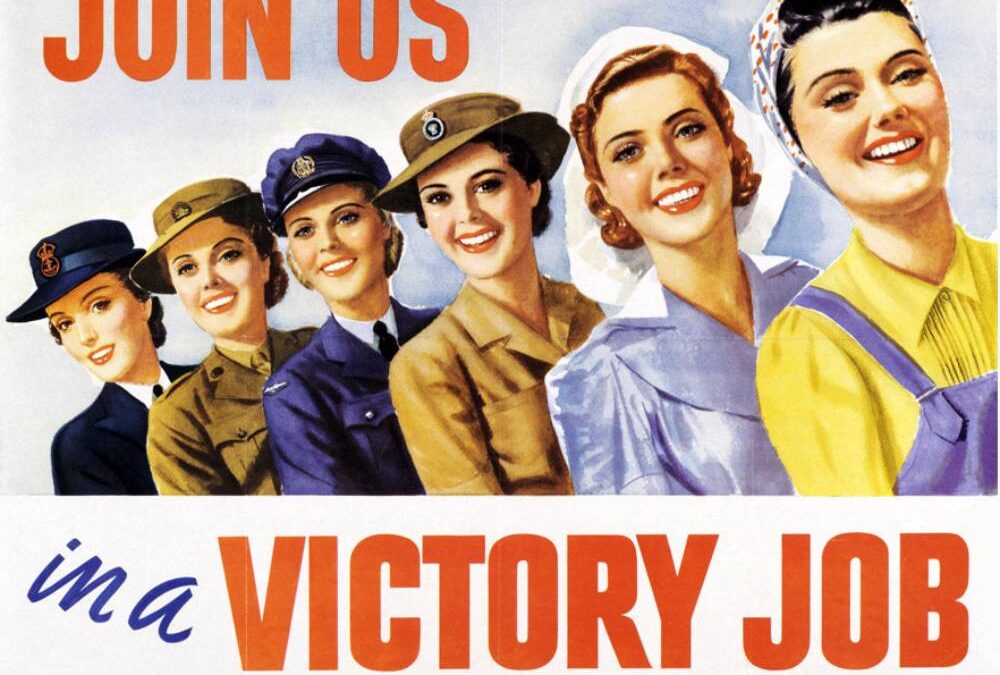
Victory Visitors distributed flyers and posters showing confident women at work with slogans like “Women in War Jobs—We Can’t Win Without Them!” These materials, often produced by the War Manpower Commission, reinforced their in-person visits.
At the height of the war (1943–44), the Victory Visitors’ campaign helped the female workforce grow dramatically—women made up nearly one-third of the Kaiser Shipyard labor force, including thousands of former housewives.
Weren’t they amazing?
Please follow this blog and comment! I love reading comments!
Stay tuned for the next blog, Childcare during WW II.
This slideshow requires JavaScript.
Saturday, Oct 25, 2025 |
The unexpected behind the scenes of producing my second book: She Built Ships During World War II. You will be quite surprised!
After publishing She Flew Bombers, I became increasingly curious about the women on the Home Front during the war and what their experience was like.
After conducting extensive written research, I sought to discover new information that I had never heard about before.
I was interested in visiting the local Richmond, California, Museum, which was well known for information about women on the Home Front.
I called the museum to find out the location and hours. I was astonished to learn that I needed to make an appointment. I had visited many museums in my life, but I was never told that I needed to make an appointment to go to a public museum.
Fortunately, my hardworking, history buff husband wanted to go as well. We drove to the museum, an hour away from home. I was full of anticipation on the way there to further enhance my research. We got to the stately museum and parked.
In the surrounding neighborhood, there were many abandoned buildings, open drug sales, loitering, and a gang presence. The scene before us frightened me, so I grabbed my muscular husband’s arm. Having spent most of my life in the country, comfortably sheltered, I found myself in an unusual situation. I was relieved that my husband accompanied me, as he was a big, strong-looking guy, and I felt protected with him; I wouldn’t have even gotten out of my truck if I had been alone.
I later found out that this area was widely known as the most dangerous part of Richmond, CA, and known as the Iron Triangle, and was one of the city’s highest-crime zones that included narcotics and gun activity.
My husband quickly held my hand as we walked up the multiple wide flights of stairs to the entrance door of Richmond Museum, which was historically the 1910 Carnegie public Library. On the front door, there was a sign that said, “Go to the side door.” At the side door, another sign read, “Appointment only, ring the buzzer.” I rang the buzzer, and a man pushed a curtain aside, looked out at us, and then opened the door. At this point, I felt like I was in a spy movie and wondered what would happen next!
The small older man with a clipboard asked, “Do you have an appointment?’ I replied yes and gave him our names. He checked us off and then warmly said, “Welcome to the Richmond Museum.”
There before us was a musty-smelling museum chock-full of memorabilia of World War II. There were photographs, documents, artifacts, and maps.
We were both enthralled, forgetting the dangers outside. I was so pleased and honored to explore this museum for my research.
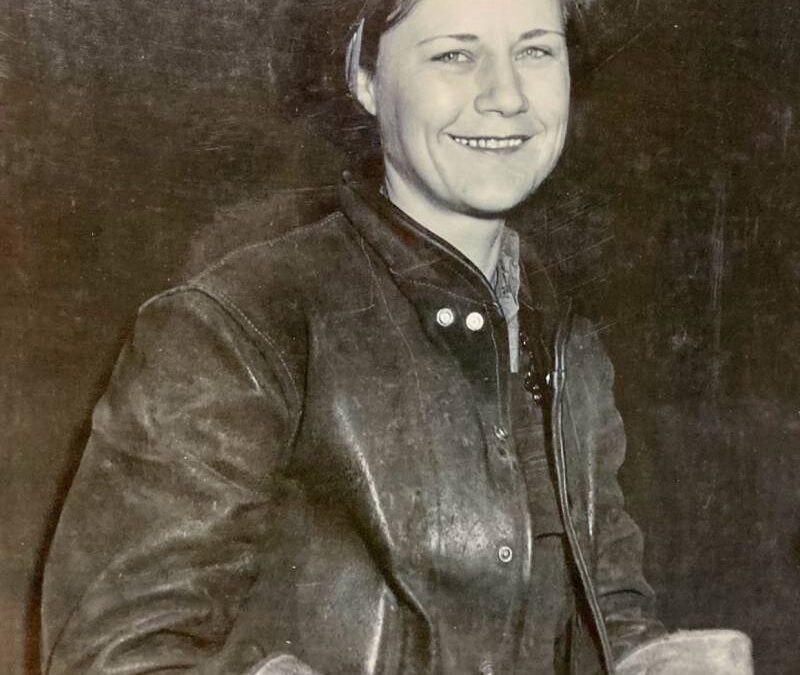
I was enamored by a 17 X 11 photograph of a gorgeous, complexioned woman with a beautiful white smile wearing a man-sized welding uniform and large work gloves. The only item that fit was her “cool” looking welding hood.
At the bottom of the photo was written Wendy the Welder, Dorothy Price, Runner-up, ‘Joan of Arc’ welding contest, Richmond Kaiser Shipyard #3, July 1943.
I bought the well-matted photograph of her and received written permission to use it for my book. It was the perfect cover for She Built Ships, and I was thrilled.
It was interesting for me to discover the phrase “Wendy the Welder” that our tour guide said used to be as popular a nickname as “Rosie the Riveter for the women on the Home Front.
Another fascinating discovery at this fine museum was to view an exhibit of watercolor paintings created by children from the Kaiser Richmond Maritime Child Development Center in 1944.
Our tour guide informed us that Richmond had about 30–35 wartime child-care/nursery units for Kaiser shipyard workers.
I took photographs of two paintings featured in my book, She Built Ships During WW II.
The first one was a watercolor painted by Joe Fitzgerald, age 8. It depicted a ship on the ocean with two Japanese airplanes being bombed during Pearl Harbor.
The second watercolor, painted by Donald, age 10, in my book, showed the outfitting dock at the Richmond Kaiser Shipyard with a rough-looking man with a wrench in his hand, wearing a hat and a long cigarette hanging out of his mouth. He was in front of 2 ships on the dock.
I was deeply moved to see how very young children painted and depicted the war. It also made me feel very sad. I was the owner/director of a large pre-school, where our children painted flowers and happy family members. When the horrific bombing of our country occurred during 9/11, I had to put a sign on the door for parents not to discuss the event at the center.
We left the museum, thanked the excellent tour guide, and cautiously went outside. We were relieved to see that our truck was not vandalized. We quickly got into our vehicle, locked the doors, and sped out of there.
On the way home, my mind wandered to the painting of the bombing of Pearl Harbor by a very young child, and it made me think about how children were exposed to war during that time. I was the owner and director of a large daycare center, and we protected our kids from frightening events, such as the 9/11 attacks on our country. I had to post a sign on the door informing parents not to discuss it. Our children painted flowers and happy family members, NOT bombings.
I placed the beautiful photograph of WENDY THE WELDER on my desk to enhance my writing.
Stay tuned for upcoming events, while writing my historical novel, She Built Ships During WW II. These activities included Victory Visitors, attending a welding class, studying the Maritime Child Development Center in Richmond, CA, and touring the Port Chicago Naval Base in Concord, CA, to learn about the devastating Port Chicago explosion.
This slideshow requires JavaScript.
Monday, Oct 6, 2025 |
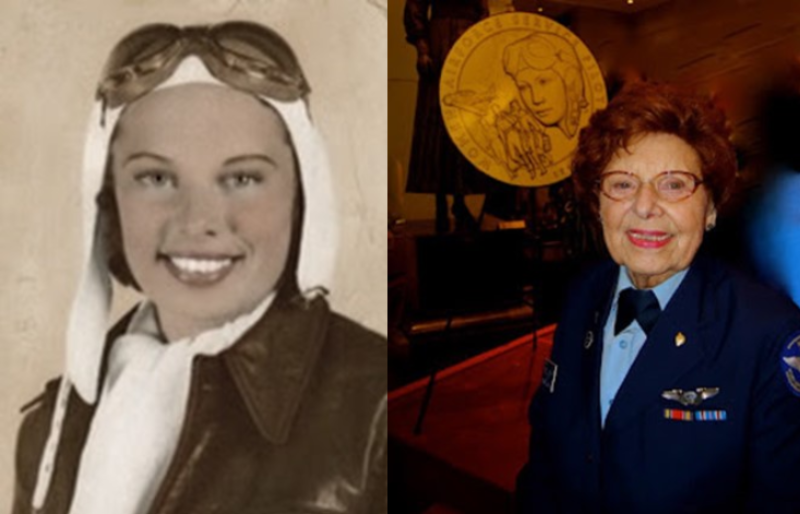
My interview with a Woman Airforce Service Pilot, Adeline Wolak Ellison in class 6, 1943 at the standing-room-only event on September 19, 2009, was hysterically entertaining.
I found my previous interview with Betty Budde, Class 43-3 a hoot, but “Addie” really topped the cake with her funny true stories as a WASP and was candid and delightfully expressive.
Please enjoy Addie Wolak’s interview:
“It took a lot of work to be a WASP, but we did manage to have fun and had many crazy things happened to us. One of the funniest was when ten of us flew our brand-new BT 13’s from Texas and were scheduled to stop in Blithe, California overnight to have our instrument ratings checked and then fly off to deliver them to an army base.
We got there and went to dinner then went to bed to be ready for our flight.
In the morning, when we went to the flightline and much to our shocking surprise there were ladders at each of our planes with GI’s disassembling them by taking out the nuts and bolts.
We screamed at them, “What are you doing? We gotta fly our airplanes out of here to another army base for the men to fly them into combat.”
One GI answered, “Well, we thought if we disabled them you could come to a big dance we are having tonight, and we only have ugly nurses to dance with!”
“I said, oh sure we can call back to our base and tell them GIs disassembled our planes and have to stay one more night!”
Thank goodness that scared all the GIs to put them back together again!”
This outrageous story caused a burst of raucous laughter from the audience.
Addie continued, “Another time I was flying a plane alone to an Army base in Midland, Texas which I was looking forward to eating steak that I heard was wonderful there.
After I landed a GI asked me if I could bowl. I said sure but I only bowl a 135.That day at the bowling alley I surprised myself and bowled a 250!
This event caused all the locals to come over and watch me bowl again thinking I was a top bowler, but then I only bowled my usual 135! After the game the GI’s and I went out to steak dinner. There was a huge group of us and a big Texan at the table announced when the bill came, “Kids, the bills on me!”
The next day one of the GI’s asked if I wanted to fly in formation with a group of them.
I answered, “Sure but only if I could be the head pilot!”
We all flew up in our planes, and the GIs purposely went up 2 at a time as the tower started screaming, “One at a time, one at a time!”
They ignored the tower and hemmed me in the middle! After 15 minutes the “stinkers” peeled off wiggling their wings at me and flew away!
Another crazy event was when a bunch of us gals were flying in a bomber and one of the gals wore uncomfortable large of pants and decided to take them off and folded them up and put them in the back of the plane. We were about to land when she opened the hatch and her pants flew out!
She called to the tower, “Send a lady mechanic to bring me pants because mine flew out.”
By the time the plane landed there were a huge number of male mechanics “knee deep” waiting to see a girl pilot in her underwear!”
A female mechanic brought out a surplus male size 44 coveralls for her to wear. She came out of the plane wearing the coveralls that had the crouch down to her ankles and the GI’s burst out laughing!”
Addie continued, “I hate to brag but during basic training my instructor told me that I flew better than 95% of the male pilots that he did check flights on.
The WASPs were suddenly disbanded on December 20, 1944, 8 months before the war was over and the male pilots were returning and wanted their jobs back. The WASPs were so disappointed they offered to keep flying for $1.00 a year but were still rejected. Furthermore, they were sent home without being able to celebrate the glorious end of the war together.
I married an Airforce pilot and had two children and decided to join the Airforce Reserves as a 1st Lieutenant. I was the only woman in a class of 35 men. One day I was chit-chatting with a colonel after class and I happened to mention my children to him.
He asked me, “You have children”?
I answered, “Yes, I have two.”
The colonel asked, “Is that on your record?”
I answered, “No there was nothing on the forms.”
The colonel raised his voice, “I’m sorry but you can’t be in the Air Force reserves if you have a family unless you put them up for adoption!”
A wave of laughter rolled through the audience.
The colonel continued, “Since the class is half over, I will give you an honorable discharge.”
“He broke my heart, and I knew I surely would have become a colonel just like him if he had let me stay.”
Clapping broke out from the audience.”
As MC I said, “Addie’s daughter Andrea is in the audience and I’m sure she’s glad that she was not put up for adoption.”
The interview of the six WASPs concluded with Q & A from the audience.
Nancye Crout listed all the many planes she got to fly.
Florence Emig Wheeler attended all the yearly reunions that continue to happen. Last year’s reunion had 100 WASPs attending.
Florence Wheeler was a pilot instructor and flew until she was 72 and had taught her 56-year-old father to fly and get his pilot’s license.
I had heard on the radio that the WASPs were to receive the Gold Medal of Honor on March 10, 2010.
I called up Florence Wheeler and asked her if she was going to Washington for her Medal of Honor.
Florence answered, “I’m thinking about it.”
I asked, “Will they pay for your trip and hotel expenses?”
Florence answered, “No.”
I responded, “That’s terrible.”
Florence replied, “This is nothing new and has always been this way in the army.”
Adeline Ellison added, “It was one of the highlights of my life to travel to Washington, DC to receive the Gold Medal of Honor.”
In 2012, a Cessna 172 was named “ADELINE,” was unveiled by owner Ralph Sauceda in a special honor given to Addie at the Commemorative Air Force, Modesto, California Airport.
Adeline Wolak Ellison was born on September 26, 1919, in Chicago, Illinois. She Died on June 10, 2017, at the age of 97 1/2 years old. On her gravestone it reads, “Two Hot Pilots Together at Last.”
This concludes the last interview of six WASPs. An amazing DVD was filmed by the Cmedia Lab in Santa Rosa is available to buy from my web site: www.jeaneslone.com/shop.

Friday, Sep 19, 2025 |
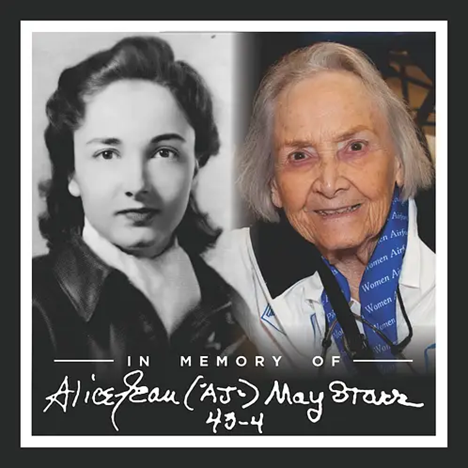
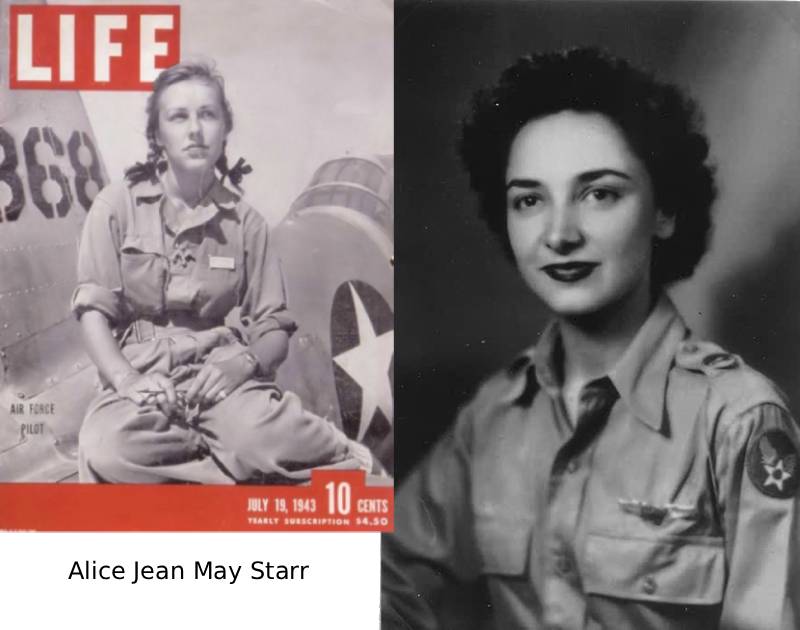
The amazing adventures of Alice Jean May Starr (A.J.) serving in the Women Airforce Service Pilots during WW II class 4, 1943 and the tragic death of her classmate, Hazel Lee.
“As a young child my farther took our family to the airport in New Jersey to experience the joy of watching the airplane take-offs and landings.
I was fortunate to live during the time of Charles Lindbergh’s flight in 1927 then Amelia Earhart’s solo flight across the Atlantic in 1932.
As a young woman I attended a lecture by Amelia Earhart at my local New Jersey high school and waited for Amelia to come out of the building and asked her for her autograph.
In 1940 while I was in art school, I was so inspired by Amelia that I was determined to learn how to fly and joined the Women Flyers of America as a charter member in New York where I earned gold wings after 7 months of training. I was the first student of the WFA program to solo! Then flying was cut out in the East Coast due to the upcoming war and I read about the WASPS in Life magazine and applied but there was no room so I joined the US Navy station in Atlanta, Georgia and trained as an instructor in the use the link trainers (see blog of Florence Wheeler) and tested other pilots.
At last, I was called to join the WASPs, and I took a cattle train to Sweet Water, Texas and went to Pursuit fighter plane school and learned to fly the P-40, P-47 Thunderbolt, and P-51 Mustang.
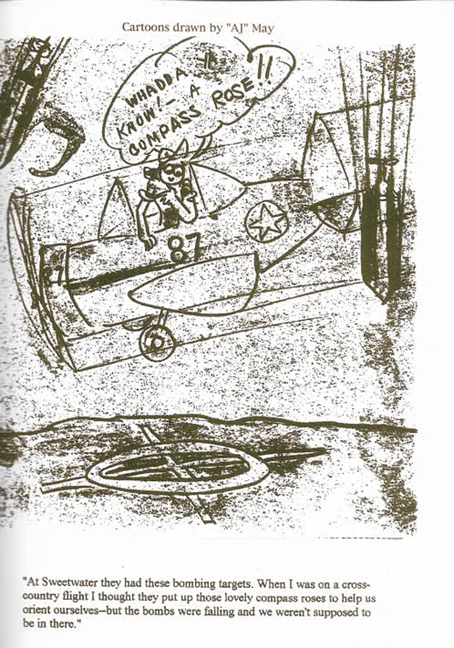
One day at Sweetwater, I let the cat out of the bag that I could play the bugle, so I got slapped with the job of playing Reveille at dawn and Taps at the end of the day ordered by Director Jackie Cochran. There was a woman who worked in the hangars at night, and wept every time she heard me blow taps, as she had lost her husband in the war,”
Jeane Slone, MC at the Santa Rosa Vets building event gently asked A.J. Starr: “I know one of your classmates died in a tragic accident ferrying airplanes from the factories to the army bases for the men to fly into combat are you willing to talk to us about this?”
Alice answered, “Yes, Hazel Lee was one of my classmates, the first Chinese American girl who graduated in the WASPs in October 1943. She was flying a P-63 King cobra from the factory to Great Falls, Montana, and did everything correctly to get there. We flew many Pursuit fighter airplanes for the Soviet Union 588th all women night bomber regiment to pick and then bomb the Germans.
A male pilot’s radio conked out and he should have stopped his plane which was required by the regulations. Hazel made a long final approach, but the male pilot took a short final approach. Hazel pulled up and crashed into the other pilot. She lived for two days, as a burn victim. Because WASPs were classified as civilians, the military did not cover her funeral expenses, and her family had to pay to transport her body back to Portland.
It was so unfortunate that her death was only a month before the WASPs were disbanded. I was given the opportunity to drive her car back to her relatives.
After the WASPs were disbanded for returning male pilots to take over in December 1944, eight months before the war was ended, I worked for a surplus aircraft company, ferrying out worn bomber airplanes.
Every day I had in the Women’s Airforce Service Pilots was an adventure, and I would’ve missed it for the world. I had the chance of a lifetime to fly many pursuits plus cargo planes, and Bombers and my favorite airplane the sleek P-51 Mustang.”
The audience exploded into applause as A.J. Starr finished her lecture.
Alice Jeane Starr was born on 7/17 /1920 and lived to the long well-lived life of 102 on 6/28/2023.
To hear all the stories collected of the Women’s Airforce Service Pilots, you can purchase the DVD audio of their stories in our shop!
Click the image below to shop now!