
The unexpected behind the scenes of producing my second book: She Built Ships During World War II. You will be quite surprised!
After publishing She Flew Bombers, I became increasingly curious about the women on the Home Front during the war and what their experience was like.
After conducting extensive written research, I sought to discover new information that I had never heard about before.
I was interested in visiting the local Richmond, California, Museum, which was well known for information about women on the Home Front.
I called the museum to find out the location and hours. I was astonished to learn that I needed to make an appointment. I had visited many museums in my life, but I was never told that I needed to make an appointment to go to a public museum.
Fortunately, my hardworking, history buff husband wanted to go as well. We drove to the museum, an hour away from home. I was full of anticipation on the way there to further enhance my research. We got to the stately museum and parked.
In the surrounding neighborhood, there were many abandoned buildings, open drug sales, loitering, and a gang presence. The scene before us frightened me, so I grabbed my muscular husband’s arm. Having spent most of my life in the country, comfortably sheltered, I found myself in an unusual situation. I was relieved that my husband accompanied me, as he was a big, strong-looking guy, and I felt protected with him; I wouldn’t have even gotten out of my truck if I had been alone.
I later found out that this area was widely known as the most dangerous part of Richmond, CA, and known as the Iron Triangle, and was one of the city’s highest-crime zones that included narcotics and gun activity.
My husband quickly held my hand as we walked up the multiple wide flights of stairs to the entrance door of Richmond Museum, which was historically the 1910 Carnegie public Library. On the front door, there was a sign that said, “Go to the side door.” At the side door, another sign read, “Appointment only, ring the buzzer.” I rang the buzzer, and a man pushed a curtain aside, looked out at us, and then opened the door. At this point, I felt like I was in a spy movie and wondered what would happen next!
The small older man with a clipboard asked, “Do you have an appointment?’ I replied yes and gave him our names. He checked us off and then warmly said, “Welcome to the Richmond Museum.”
There before us was a musty-smelling museum chock-full of memorabilia of World War II. There were photographs, documents, artifacts, and maps.
We were both enthralled, forgetting the dangers outside. I was so pleased and honored to explore this museum for my research.
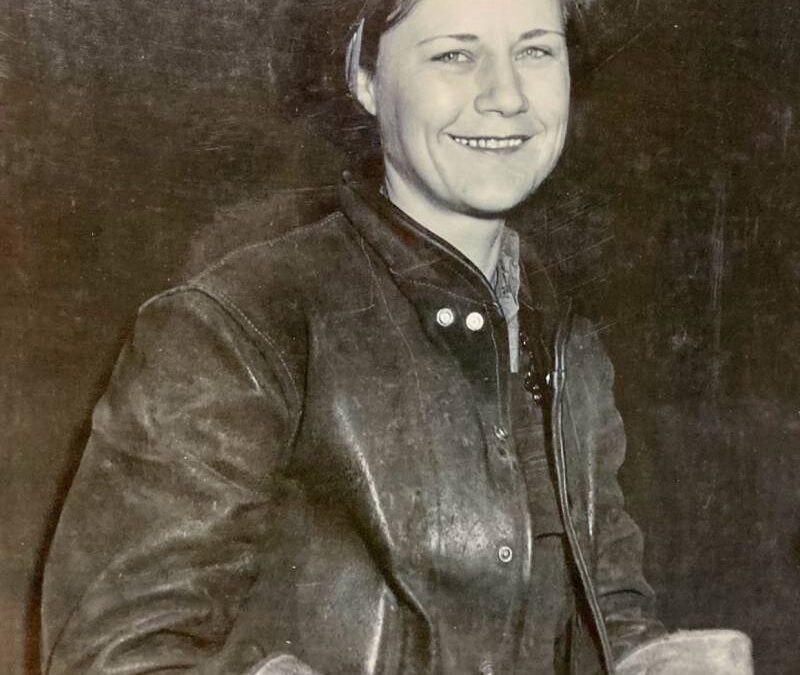
I was enamored by a 17 X 11 photograph of a gorgeous, complexioned woman with a beautiful white smile wearing a man-sized welding uniform and large work gloves. The only item that fit was her “cool” looking welding hood.
At the bottom of the photo was written Wendy the Welder, Dorothy Price, Runner-up, ‘Joan of Arc’ welding contest, Richmond Kaiser Shipyard #3, July 1943.
I bought the well-matted photograph of her and received written permission to use it for my book. It was the perfect cover for She Built Ships, and I was thrilled.
It was interesting for me to discover the phrase “Wendy the Welder” that our tour guide said used to be as popular a nickname as “Rosie the Riveter for the women on the Home Front.
Another fascinating discovery at this fine museum was to view an exhibit of watercolor paintings created by children from the Kaiser Richmond Maritime Child Development Center in 1944.
Our tour guide informed us that Richmond had about 30–35 wartime child-care/nursery units for Kaiser shipyard workers.
I took photographs of two paintings featured in my book, She Built Ships During WW II.
The first one was a watercolor painted by Joe Fitzgerald, age 8. It depicted a ship on the ocean with two Japanese airplanes being bombed during Pearl Harbor.
The second watercolor, painted by Donald, age 10, in my book, showed the outfitting dock at the Richmond Kaiser Shipyard with a rough-looking man with a wrench in his hand, wearing a hat and a long cigarette hanging out of his mouth. He was in front of 2 ships on the dock.
I was deeply moved to see how very young children painted and depicted the war. It also made me feel very sad. I was the owner/director of a large pre-school, where our children painted flowers and happy family members. When the horrific bombing of our country occurred during 9/11, I had to put a sign on the door for parents not to discuss the event at the center.
We left the museum, thanked the excellent tour guide, and cautiously went outside. We were relieved to see that our truck was not vandalized. We quickly got into our vehicle, locked the doors, and sped out of there.
On the way home, my mind wandered to the painting of the bombing of Pearl Harbor by a very young child, and it made me think about how children were exposed to war during that time. I was the owner and director of a large daycare center, and we protected our kids from frightening events, such as the 9/11 attacks on our country. I had to post a sign on the door informing parents not to discuss it. Our children painted flowers and happy family members, NOT bombings.
I placed the beautiful photograph of WENDY THE WELDER on my desk to enhance my writing.
Stay tuned for upcoming events, while writing my historical novel, She Built Ships During WW II. These activities included Victory Visitors, attending a welding class, studying the Maritime Child Development Center in Richmond, CA, and touring the Port Chicago Naval Base in Concord, CA, to learn about the devastating Port Chicago explosion.